
FLORIDA BASED
VETERAN OWNED
ENGINEERING
A MORE RESILIENT WORLD
Independent AI infrastructure, powered by SpinG™.
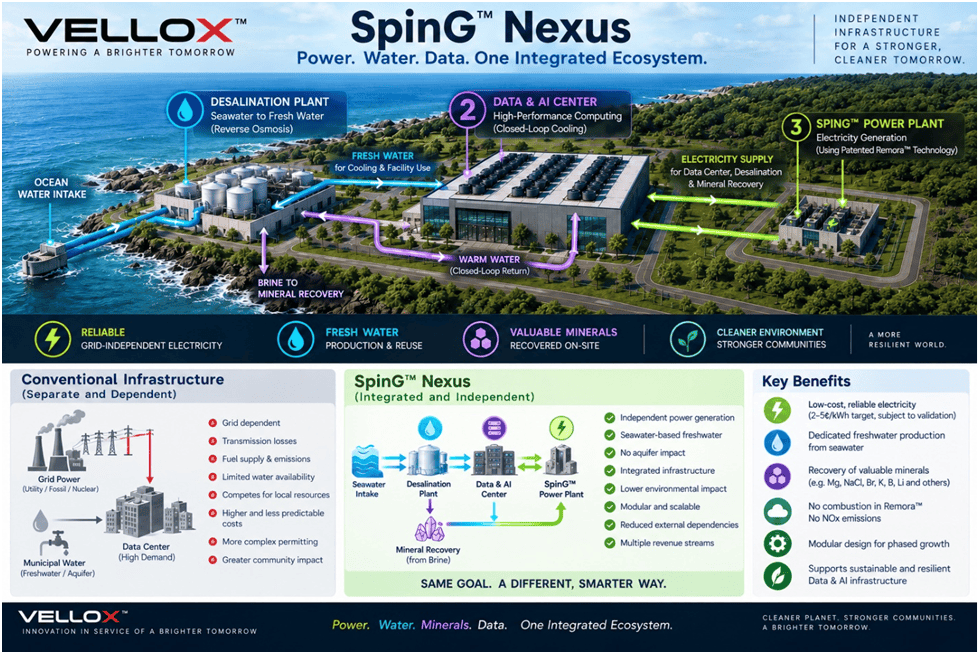
SpinG™ Nexus™ is Vellox’s vision for a new generation of coastal AI and data-center infrastructure: a coordinated campus designed to produce reliable electricity, secure its own freshwater supply, and convert desalination brine from a disposal challenge into a potential source of useful industrial minerals.
Subject to industrial prototype validation.
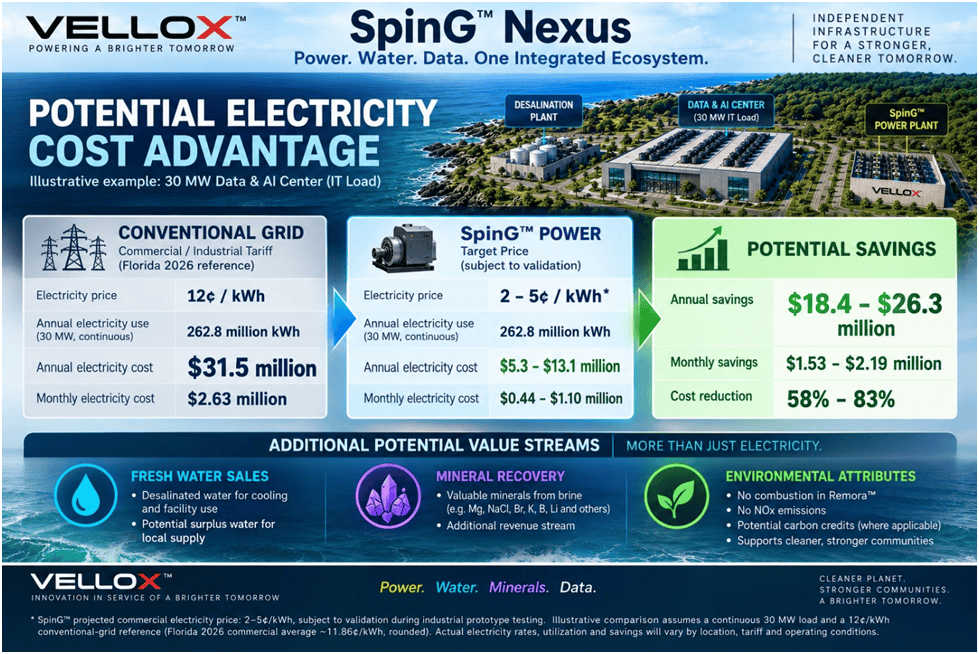
Illustrative 30 MW continuous-load comparison. The SpinG™ commercial price target and all projected savings remain subject to industrial prototype validation and will vary by site, tariff, utilization, design, and operating conditions.
This suggests a potential electricity-cost reduction of approximately $18.4–$26.3 million per year, or about 58%–83%, before considering any additional potential value from freshwater sales, mineral recovery, or qualifying environmental attributes.
SpinG™ projected commercial electricity price: 2–5¢/kWh, subject to validation during industrial prototype testing. The comparison above assumes a continuous 30 MW load and a 12¢/kWh conventional-grid reference. Actual electricity rates, utilization, system performance, and savings will vary by location, tariff, engineering configuration, and operating conditions.
Depending on site chemistry, recovery technology, market conditions, and economic feasibility, potential products may include magnesium compounds, industrial salt, bromine, potassium compounds, boron products, and other useful materials. This platform is intended to reduce brine-disposal impact while supporting domestic mineral supply and new industrial activity.
SpinG™ Nexus™ is designed to integrate seawater desalination with a dedicated water supply for Data & AI infrastructure. Desalinated water would be treated to the quality required for cooling-system makeup and other facility needs.
Within the data center, cooling water would circulate through a separate cooling loop, transferring heat to the selected heat-rejection system and returning for reuse. Makeup water would replace losses where required by the cooling design.
The concentrated brine produced by desalination would remain separate from the cooling loop and could be directed to a mineral-recovery process, subject to technical, economic and environmental evaluation.
Final water demand, treatment requirements and cooling performance would depend on site conditions, the selected cooling technology and engineering validation.
Electricity for mission-critical computing • Freshwater for cooling and local use • Potential industrial products from brine • Potential environmental attributes where applicable
The proposed campus coordinates power generation, water production, computing and potential mineral recovery. Shared planning and controls would match these activities to facility demand, maintenance requirements and site conditions.
SpinG™ Nexus™ brings power, water and Data & AI infrastructure into one coordinated campus concept. Its development would proceed from validated power technology to an integrated demonstration and phased deployment, with potential benefits for surrounding industries and communities evaluated for each site.
SpinG™ Nexus™ is intended to advance through disciplined, verifiable stages. Technology validation comes first, followed by an industrial prototype, an integrated demonstration, and then phased commercial deployment. This sequence allows technical performance, safety, certification requirements, operating economics, and environmental considerations to be evaluated before large-scale rollout.
Validate the Remora™ and SpinG™ platform under controlled industrial-prototype conditions.
Demonstrate coordinated operation of power generation, data-center support, desalination, water reuse, controls, and brine management at an appropriate scale.
Develop modular campuses that can add capacity in phases and adapt to local data, water, mineral, permitting, and community requirements.
Vellox is developing SpinG™ Nexus™ around a U.S.-manufacturing strategy that emphasizes Florida-based production, domestic assembly, advanced control electronics, skilled workforce development, and resilient supply chains. The objective is not only to supply new infrastructure, but also to strengthen the industrial capability required to build and support it.
Vellox combines long-term technology development, an expanding intellectual-property portfolio, university collaboration, industrial relationships, and veteran-led leadership. This foundation supports a practical progression from prototype validation to scalable infrastructure.
Instead of competing with a community for scarce electricity and freshwater resources, SpinG™ Nexus™ is designed to generate the power and produce the water required by Data & AI infrastructure—with modular capacity that can expand as demand grows.
Where technically, commercially and regulatorily appropriate, additional capacity could potentially support surrounding industries and communities, reducing pressure on existing power grids, municipal water systems and freshwater reserves.